
A RIDE FOR LIBERTY: FUGITIVITY AND THE BLACK IMAGINATION / CHRISTIAN GINES
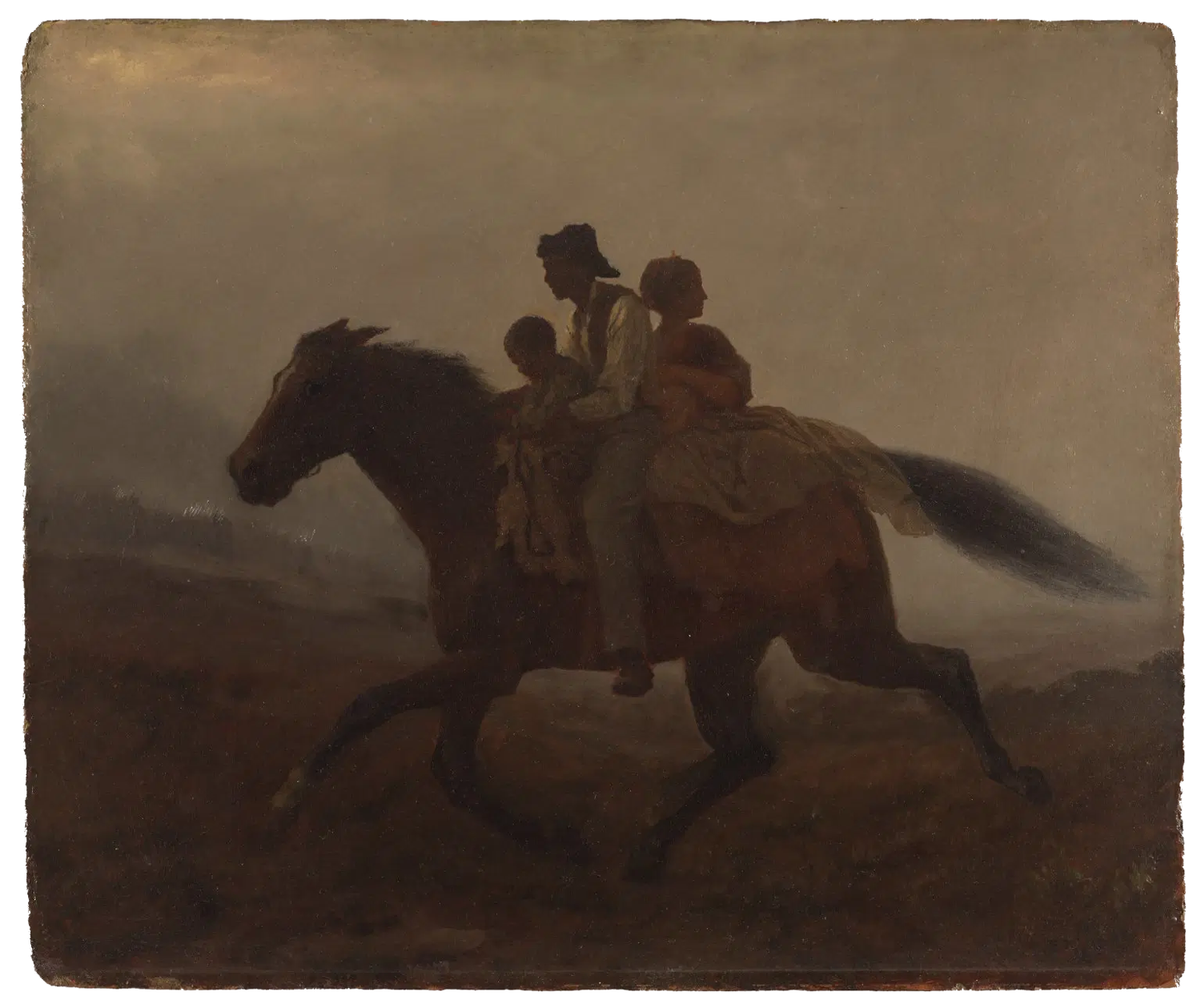
Painted by Eastman Johnson around 1862 and later titled A Ride for Liberty -- The Fugitive Slaves, the image captures a moment of self-emancipation during the Civil War.
“Steal away, steal away, steal away to Jesus! Steal away, steal away home, I hain't got long to stay here.”
— American spiritual
“There is in fact nothing you can do by the false and bloody instrument of yourself…You can’t steal something by yourself. You can’t steal away by yourself. You can’t steal yourself. You can’t feel yourself. You can’t feel bad all by yourself.”
— Fred Moten and Stefano Harney, All Incomplete
“The slave went free, stood a brief moment in the sun and then moved back again toward slavery.”
— W. E. B. Du Bois, Black Reconstruction
Blackness has long been imagined, defined, and reborn through flight and the ceaseless pursuit of a freedom never fully within reach. Eastman Johnson’s A Ride for Liberty – The Fugitive Slaves (recto) captures this tension between enslavement and self-determination. In the painting, a family rides on horseback across a dim, barren landscape. The father holds a young child in front of him, while the mother sits behind, glancing over her shoulder and possibly swaddling a newborn in her arms. The scene is suspended in motion and frozen mid-flight. Time, race, and status are crystallized into a single, perilous moment. The woman’s backward gaze suggests the omnipresent threat of capture, even as dawn breaks ahead. Freedom feels imminent yet uncertain.
According to the Brooklyn Museum, which houses the painting, Johnson claimed to have based this scene on an event he witnessed near a battlefield in Manassas, Virginia, on March 2, 1862, just before Confederate forces surrendered the site to Union troops.1 Yet the historical accuracy of this account is ultimately secondary. What matters is the painting’s imaginative power, envisioning not a secure freedom but the fragile possibility of becoming free. Through this work, Johnson transforms observation into speculation, crafting a visual meditation on what flight from slavery might look and feel like.
Fred Moten and Stefano Harney describe this condition as a form of “radical homelessness.”2 Building on this idea, Rizvana Bradley argues that Western aesthetic tradition was constructed through exclusions that prevent Blackness from ever fully belonging within it.3 If this is the case, then Johnson’s painting reveals how Black life enters the aesthetic not as something settled or “at home,” but as a disruptive, fugitive force that exceeds the very frameworks designed to contain it. Seen in this light, the painting visualizes Blackness as an aesthetic of flight that resists subjugation and remains in perpetual motion.
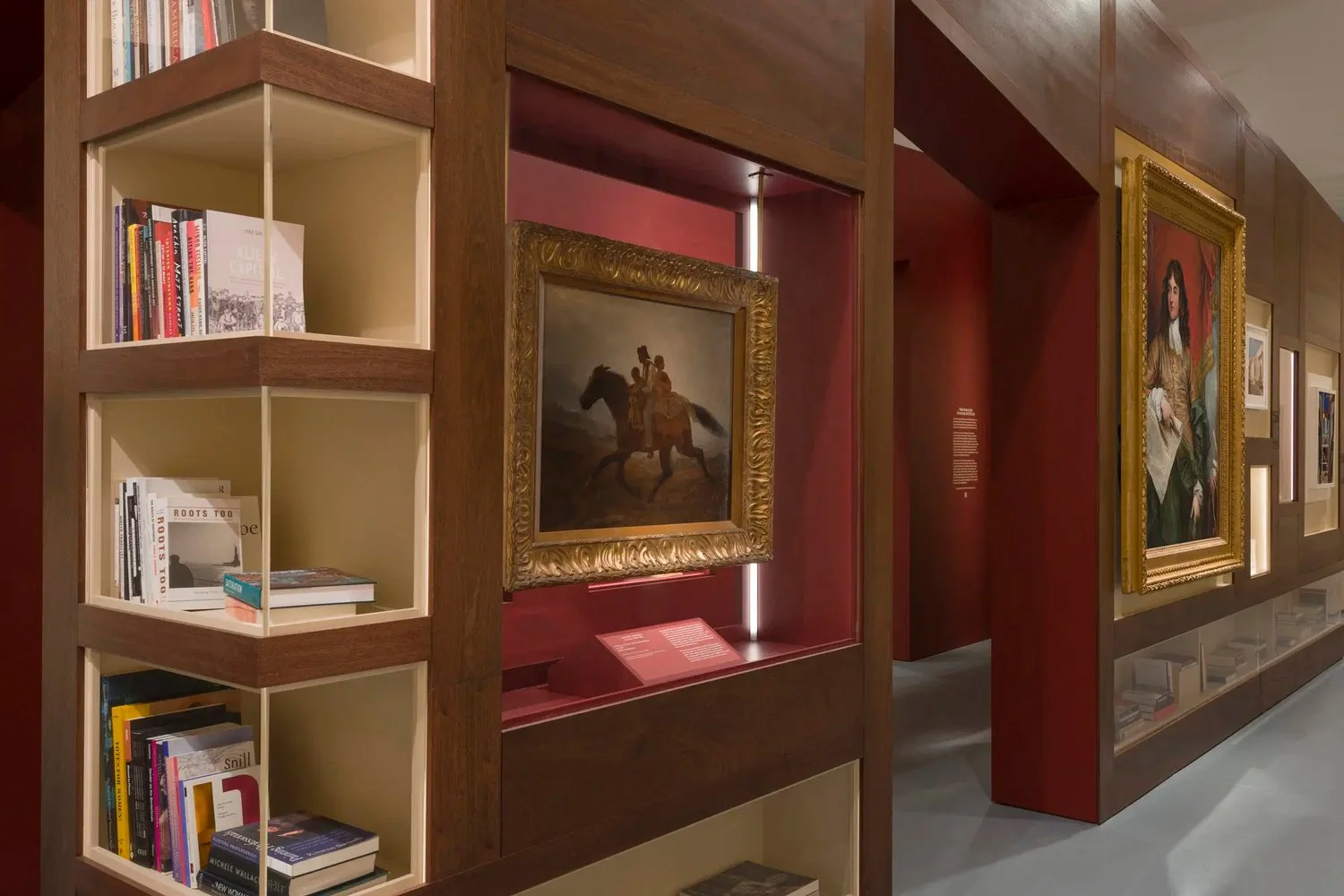
A Ride for Liberty figures prominently in Toward Joy: New Frameworks for American Art, the recent reinstallation of the Brooklyn Museum's American wing.
Fugitivity here is not simply an escape from bondage but an ongoing process of creating freedom as a lived practice. The family’s urgent movement across the landscape embodies what W. E. B. Du Bois later described as the “brief moment in the sun,” the instant when emancipation feels both tangible and fleeting.4 The light rising on the horizon suggests not only the coming of dawn, but also the emergence of a world still in the process of being imagined.
Stealing oneself away, as encapsulated in A Ride for Liberty, planted seeds of new possibility while refusing the logics of capitalism and slavery. Crucially, to steal oneself away was not to claim ownership over the body in a way that aligns with Western liberal values about property. Rather, it was to assert that no one and no institution has a claim over a body or a person, particularly for those forced into the liminal space between subject and object as sentient beings treated as fungible commodities.
Beyond rejecting the capitalist devaluation of Blackness and Black life, stealing oneself away also ruptures the moral and legal order of modernity itself. When one’s status is reduced to what Hortense Spillers calls “being for the captor,” flight becomes a vehicle for new forms of being.5 In Johnson’s composition, the open landscape, endless horizon, and rising sun isolate and illuminate the expanding possibilities of Black life and freedom within this moment of escape.

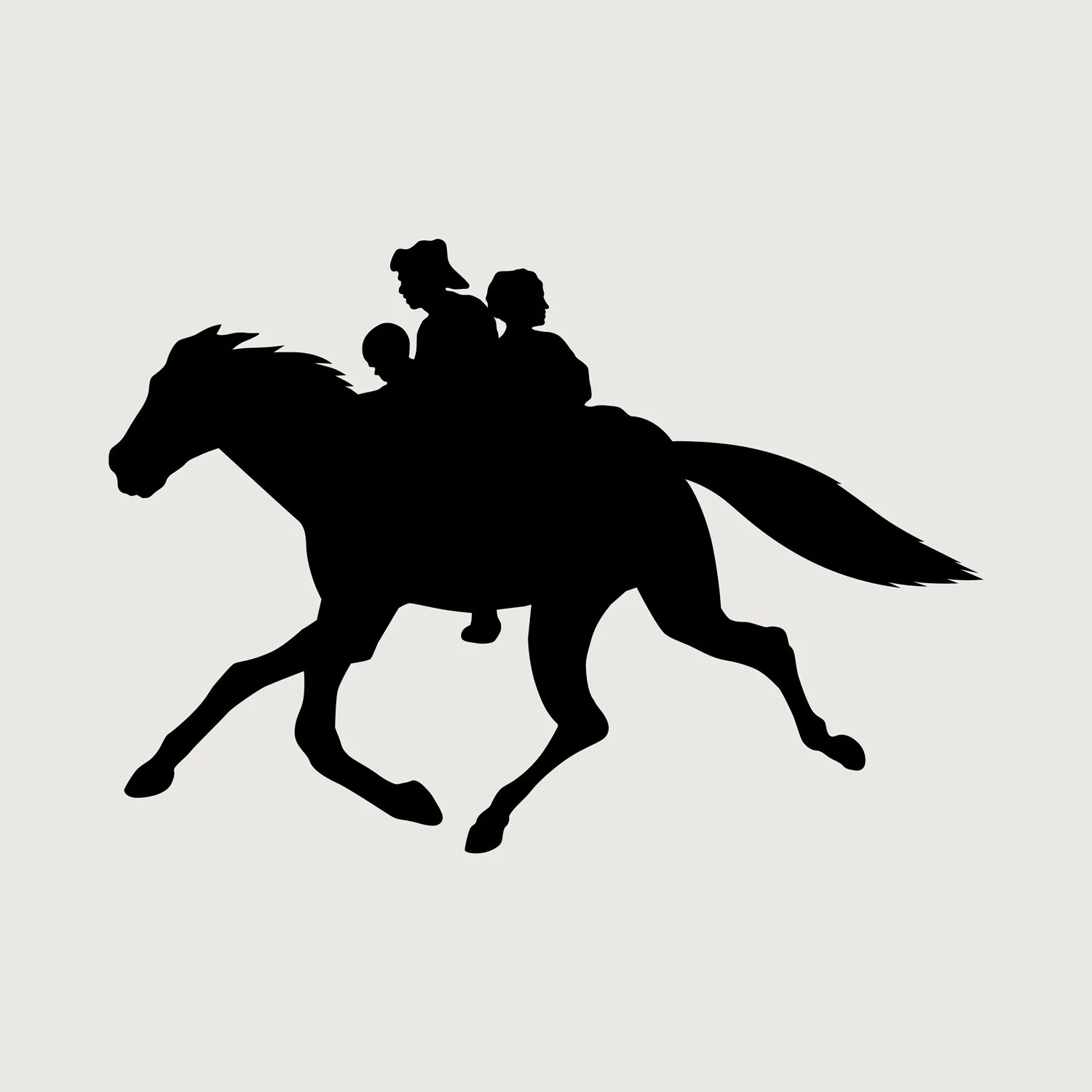
North Star followers weighed in. Nearly half favored the original compass rose, while a slight majority gravitated toward the Eastman-inspired silhouette.
This brings the discussion to why A Ride for Liberty has been considered as a potential source for a future North Star logo. The painting offers a compelling counterpoint to the current compass rose, which evokes imagined freedom and the aspirational pull of the distant. In contrast, a silhouette derived from Johnson’s composition conveys material action and embodied movement. It suggests a shift from the distant to the immediate, from the idealized to the lived, from the promise of freedom to the practice of fugitivity. In this sense, A Ride for Liberty opens a productive space for reflecting on how North Star might visually engage both the history and the praxis of Black liberation.
In this image, we see what North Star strives to embody: the continual pursuit of freedom through creativity. By linking the historical, philosophical, and spiritual dimensions of Black life to the material practice of making and wearing, the brand uses fashion as a language of fugitivity—a medium for imagining liberation not as a destination but as a movement.
1 Eastman Johnson, A Ride for Liberty – The Fugitive Slaves (recto), ca. 1862, oil on paperboard, 21 15/16 x 26 1/8 in. (55.8 x 66.4 cm), Brooklyn Museum,
https://www.brooklynmuseum.org/tr-TR/objects/495.
2 Fred Moten and Stefano Harney, All Incomplete (New York: Minor Compositions, 2021), 45.
3 Rizvana Bradley, Anteaesthetics: Black Aesthesis and the Critique of Form (Chicago: University of Chicago Press, 2023).
4 W. E. B. Du Bois, Black Reconstruction in America, 1860-1880 (New York: The Free Press, 1998), 30.
5 Hortense J. Spillers, “Mama’s Baby, Papa’s Maybe: An American Grammar Book,” Diacritics 17, no. 2 (Summer 1987): 72.